
PORTLAND, Ore. – A nonprofit seeking to restore the Washington Park and Zoo Railway’s former route to the International Rose Test Garden says it has raised more than $60,000 toward the first phase of planning.
Friends of Washington Park & Zoo Railway must raise $200,000 from the community before Metro contributes another $50,000 toward the $250,000 phase. The money would fund updated engineering work and a feasibility study examining the longer route’s safety, staffing needs and financial viability.
“We’ve already received $60,000 in donations for this next phase, so we’ve been getting some incredible support,” said Kathy Goeddel, president of the Friends group.
Goeddel said the organization has not launched a broad public fundraising campaign because it first wants agreements in place with Metro and the city of Portland.
The Metro Council voted unanimously in February to continue working with the city and the nonprofit on planning and funding for a possible restoration. Mayor Keith Wilson also expressed support for the effort in a letter to Metro, Goeddel said. The city owns the trains and tracks, while Metro operates the Oregon Zoo.
No agency has given final approval to restore the route. Goeddel said the feasibility work must show that the railway could operate safely and reliably, attract enough workers and generate enough revenue to support its operation.
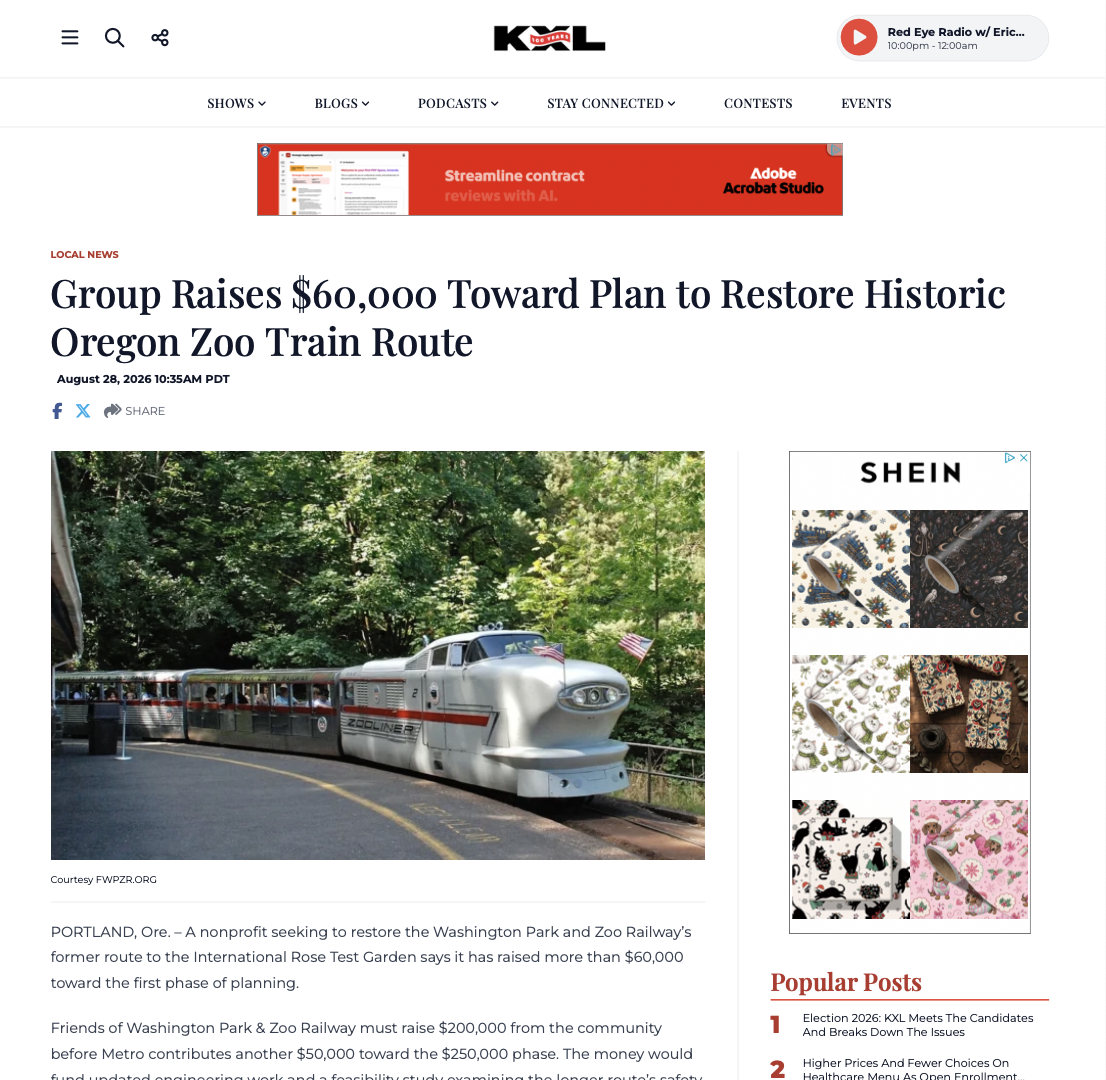
The railway began carrying paying passengers in June 1958, while workers still built what was then called the Portland Zoological Gardens, according to a history compiled by the Friends group. Ticket revenue helped pay for zoo infrastructure and an extension of the railway.
The Rose Garden Loop opened in 1960 and carried passengers through the forest to Washington Park Station near the International Rose Test Garden. Unlike most zoo trains that circle their grounds, Portland’s train gave riders a destination where they could get off, picnic or visit a playground before returning to the zoo.
“It was about a 25-minute ride,” Goeddel said. “So having their little kids encased in the zoo train, going through the beautiful cool woods, was quite an experience.”
The entire railway closed during zoo construction in 2013. A shorter loop reopened inside the zoo in 2014, but the Rose Garden route remained closed. Goeddel said a retaining wall along the former route failed in spring 2014 while service remained suspended.
The nonprofit formed after neighbors learned in 2018 that the longer route might not return. Since then, more than 45,000 people have signed a petition supporting its restoration, according to the organization. Volunteers have cleared sections of track, commissioned geotechnical work and developed accessibility plans for Washington Park Station. The group also secured a place on the National Register of Historic Places for the Portland Zoo Railway Historic District.
The group’s history says the railway carried more than 7 million passengers and generated more money than it cost to operate. It reported $1.9 million in net operating revenue during the final four years before the 2013 shutdown.
Goeddel said early estimates put additional planning and design work at roughly $300,000 and construction at about $2.7 million. The first-phase studies would update those estimates before supporters seek money for construction.
“I’m personally very confident,” Goeddel said. “But as you know, it’s Metro and the city, and they’re very big, conservative, risk-averse organizations. So we need to go through the steps to demonstrate that it’s safe, reliable and can be done.”